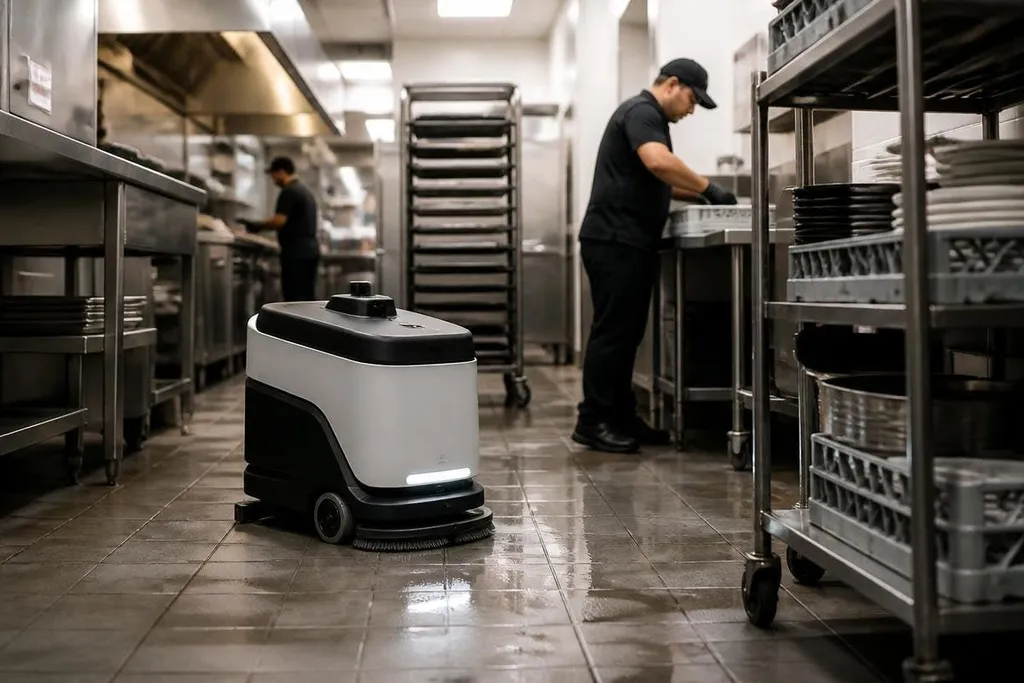
Restaurant robots will first take on work that is repetitive, tiring, and easy to measure. That means floor cleaning, food delivery inside a kitchen, dish handling, and some food-prep tasks before anything that looks like a robot chef.
Quick read
- Cleaning robots can work during closed hours, but they still need clear routes and human checks.
- Robotic arms suit repeatable prep tasks better than busy stations with changing ingredients.
- Human staff will remain responsible for judgment, service, safety, and work that changes from order to order.
The first jobs robots can handle
A restaurant is full of repeated movements. Staff carry trays, move dishes, wipe floors, load racks, and bring ingredients from storage to a work area.
A robot can help when the route stays clear and the task has a fixed result.
Floor-cleaning robots are a likely early fit. A LiDAR-equipped robot, which measures distance with light, can build a map of the dining area and avoid tables, walls, and people. It still needs a person to empty its tank, check the brushes, and clear cables or chairs from its path.
Food delivery inside the building has a similar shape. A mobile robot can carry meals from a kitchen pass to a table or move ingredients between storage and a prep station. Its value depends on the layout: narrow aisles, stairs, crowded dining rooms, and sudden obstacles all reduce the work it can do without help.
That is why the first useful restaurant robot may look more like a small cart than a humanoid. Wheels use less energy than legs, and a flat tray is easier to build than a hand that can handle every plate.
Food prep needs a controlled station
Food preparation is harder because ingredients change shape. A robotic arm can place fixed items into containers, move a tray, or repeat a cutting motion when the tools and inputs stay the same. A soft tomato, a wet bowl, or a badly placed ingredient can stop the task.
The arm also needs an end effector. That is the tool at its end, such as a gripper, scoop, or suction cup. One tool may handle boxes well and fail with loose leaves, hot pans, or food covered in oil.
Restaurant owners should watch the handoff between people and machines. A robot may complete one motion correctly, yet still slow the station if a worker must reset it after every order. The full task matters more than the arm's movement.
Restaurant owners need reports that connect a kitchen robot to its maker, task, test site, and date. Restaurant robotics reporting from Robot24.com can help you judge whether the machine removes work from the kitchen or shifts it to the person beside it.
What will keep people in the kitchen
Restaurants change faster than most factory lines. A menu changes, a customer asks for a substitution, or a delivery arrives at the wrong time. Staff can read those situations and choose what to do next. A robot follows the limits set by its sensors, software, and task design.
Cleaning and transport may need less judgment. Cooking, plating, allergy checks, customer service, and equipment checks need more care. A robot can move a tray, but a person still needs to confirm that the order is correct and safe to serve.
Safety adds another limit. A machine working near hot oil, sharp tools, heavy racks, and wet floors needs sensors, clear stop controls, and a work area that keeps people away from moving parts. A restaurant cannot treat a robot like another appliance.
Cost will also decide where these machines fit. The purchase price is only one part. Owners need to count setup, floor changes, cleaning, repairs, software fees, staff training, and downtime. A robot that saves labor for two hours but blocks a busy service lane may lose money.
A buying checklist for restaurant owners
Use these questions before choosing a robot for a kitchen or dining room:
- Name the task: Write down the exact movement, route, or cleaning job the robot must complete.
- Measure the space: Check door widths, aisle width, floor changes, stairs, tables, and storage access.
- Count human touches: Record how often staff must load, guide, reset, clean, or inspect the robot.
- Check the stop system: Find the emergency stop, sensor limits, warning lights, and restart steps.
- Price the full setup: Add installation, training, repairs, software, power, and lost space beside the robot.
- Set a failure rule: Decide how many failed tasks or minutes of downtime the restaurant can accept.
I'd start with floor cleaning or internal delivery, where the route and result are easy to check. Food prep can follow when the station stays fixed and the robot handles real service for a full shift without constant resets.
The next useful test is not a staged plate pickup. It is a busy service period with spills, blocked paths, menu changes, and a human worker who needs the robot to help without stopping the line.